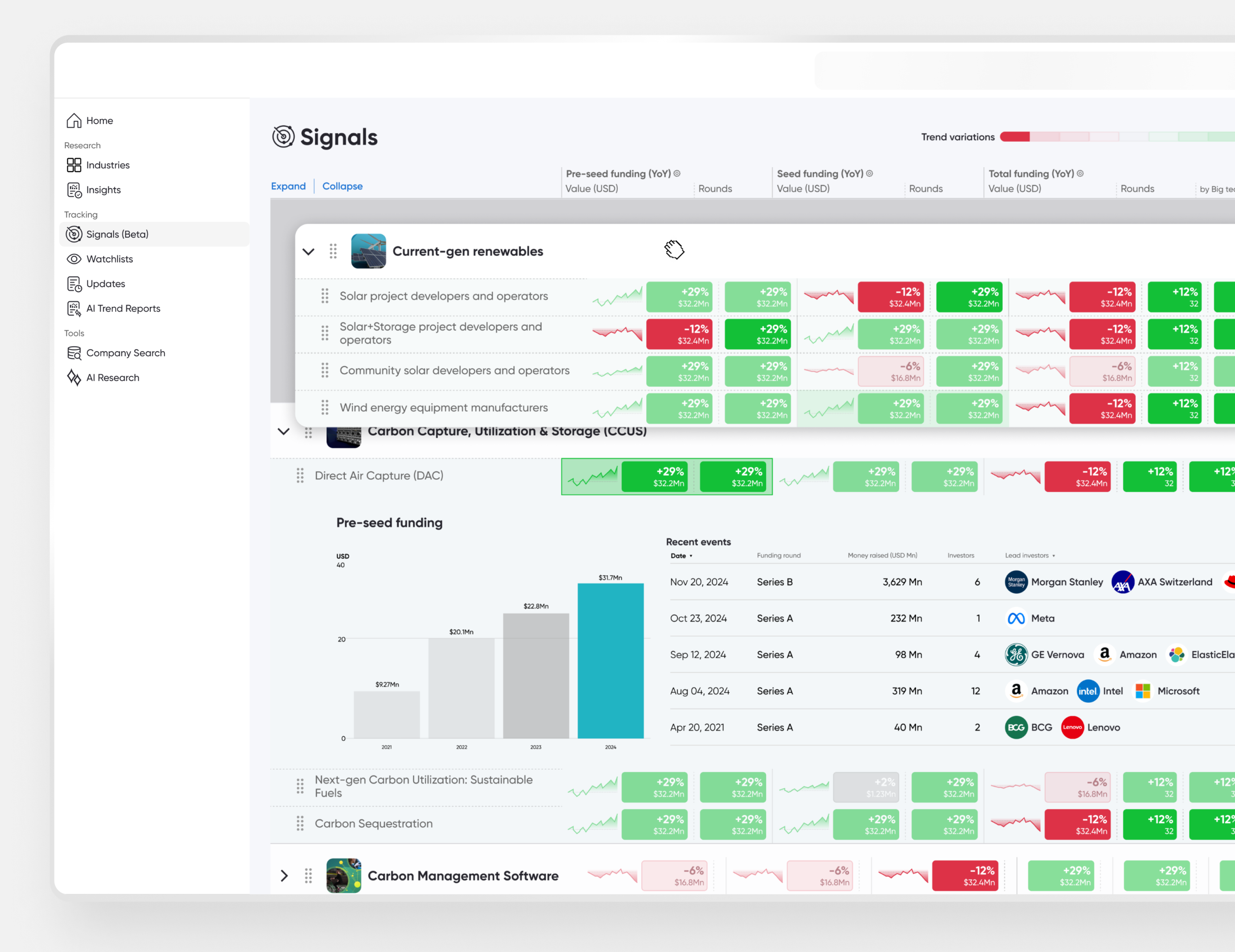
Early Innovation Trend Detection & Market Projection

Why

Strategy, innovation, and business development teams needed a way to identify where to focus next. While existing tools tracked competitor actions and past activity well, users lacked visibility into early signals and directional change across industries before trends became obvious.

What

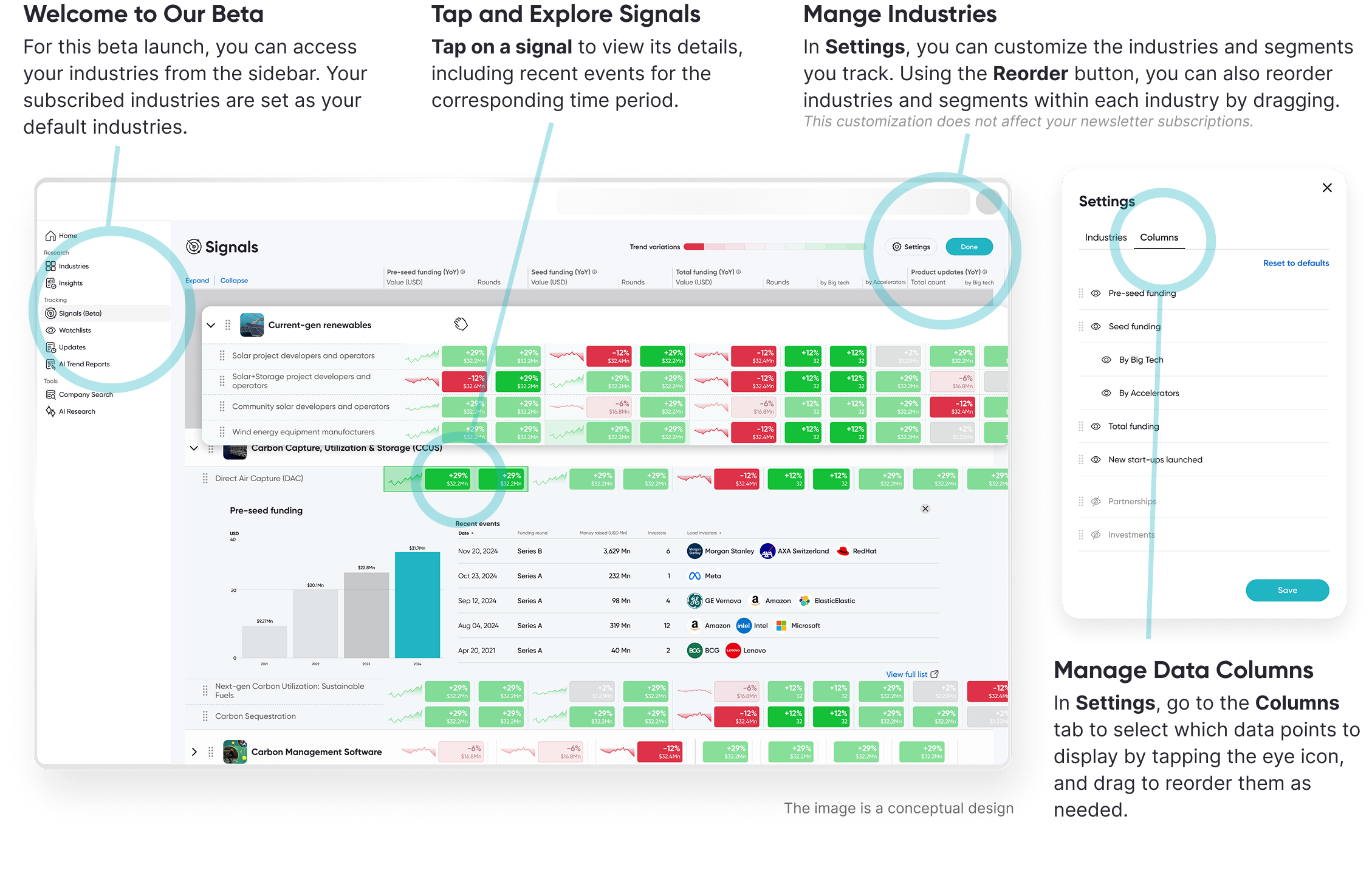
A forward-looking signal tracking feature that aggregates early indicators — including funding, product launches, partnerships, regulatory activity, and market interest — and visualizes how these signals change over time to highlight emerging momentum.

Signals complements retrospective tools by focusing on pattern recognition and predictability, helping teams prioritize areas for deeper exploration.

How

Working closely with customer success and clients, I defined a signal framework centered on change over time and scannability. The design prioritizes quick visual detection of momentum, with progressive drill-down into supporting activity, and was shipped incrementally through phased releases to validate usage and refine the model.

Project Context

Accordion Arrow
Context

Compony

Uzabase (by Carlyle Group)

Title

Head of design

Role

As a product designer, I worked closely with customer success, product, engineering, and data teams to translate recurring client needs around projection and predictability into a scalable product feature. My role included synthesizing customer insights, defining the signal framework, shaping the interaction model, and leading the end-to-end design execution through phased releases.

Project type

New feature to existing B2B SaaS product

Duration

Up to 6 months of customer success–led discovery and client operations, followed by 1 month of focused product design incorporating client feedback to define specifications, and 3 months of development for the Beta release, shipped incrementally in phases thereafter.

Product overview

EDGE Signals is a trend-tracking feature within EdgeIntel designed to help strategy, innovation, and business development teams anticipate where markets and technologies may be heading.While existing tools in the platform primarily analyze historical or competitor activity, Signals focuses on early indicators — such as funding behavior, product launches, partnerships, regulatory events, and market interest — and visualizes how these activities change over time. By highlighting momentum and directional shifts across industries, Signals enables users to identify emerging focus areas before they become obvious.

Target audience

Signals is built for forward-looking decision makers who need to determine where to focus next under uncertainty.Primary users include:

  • Strategy & Innovation teams exploring where to place future bets and initiatives
  • Product and Business Development leaders prioritizing markets, partnerships, and build vs. buy decisions
  • Corporate venture and investment teams identifying early momentum across sectors
  • Internal intelligence and research teams supporting leadership with directional insights

These users track multiple industries simultaneously and require a fast, scannable way to detect early momentum and prioritize attention — complementing more retrospective tools focused on competitor tracking.
What the client was looking for

Accordion Arrow

Across strategy, innovation, and business development teams, a recurring need emerged:
clients were not looking for more reports, but for better ways to anticipate what matters next.

Traditional reporting tools — including several features within EdgeIntel — primarily focus on backtracking:

  • summarizing past investments and partnerships
  • analyzing competitor actions after they occur
  • reporting on historical market activity

While valuable for validation and benchmarking, these tools left a gap when clients asked:

Where should we focus our attention next?

Clients wanted an experience that could surface early directional signals — even if imperfect — to guide exploration, prioritization, and internal discussions before clear outcomes were visible.

Early feedback & validation

Accordion Arrow

Initial feedback from clients consistently emphasized:

  • the value of scanning multiple industries quickly
  • the importance of seeing change over time, not just totals
  • the need for a lightweight way to justify why a focus area was emerging

Rather than expecting precise predictions, users responded positively to Signals as a decision-support tool — something that helped narrow possibilities and frame strategic conversations earlier.

This reinforced the idea that Signals should optimize for direction and momentum, not absolute accuracy.

Testing the scope through spreadsheet prototypes

Accordion Arrow

Before committing to a fully designed interface, the project scope was validated through spreadsheet-based prototypes.

Signal data was organized into tables and simple visual structures, then shared directly with select clients to test:

  • which signal types were meaningful
  • how users interpreted changes over time
  • whether relative comparison was more valuable than exact numbers

These sessions helped clarify:

  • which data points should be included in the initial release
  • how much context users needed to trust a signal
  • where visual abstraction was preferable to detailed breakdowns

This approach allowed rapid iteration on scope and logic before investing in full UI and engineering work.

Project scope

Accordion Arrow

Based on client feedback and feasibility during the Beta phase, Signals focused on the following scopes:

Funding activity

Funding by stage, total funding volume, and participation by Big Tech and accelerators

Product activity

Product updates and launch-related news volume

Partnerships & investments

Number of partnership and investment events over time

Startup emergence

Startups coming out of stealth

Market interest

Google Trends data reflecting relative search interest

Regulatory & approvals

Regulatory updates and FDA approvals, classified by event type and sentiment

Market context

TAM estimates, penetration rates, and 5-year CAGR based on proprietary models

Outcome & impact

Accordion Arrow

Signals introduced a forward-looking layer to the EdgeIntel platform, complementing existing retrospective tools such as competitor and incumbent analysis.

As a result:

  • The feature helped attract new client conversations focused on innovation and exploration use cases
  • Existing users had a stronger reason to revisit the dashboard regularly, using Signals as a scanning and prioritization tool
  • The product established a foundation for future predictive and AI-assisted capabilities within the platform

Signals shifted part of the platform’s value from explaining the past to supporting earlier, more confident decision-making.

Get in touch

I'm excited to learn about your project.
Let's collaborate to turn conceptual ideas into concrete results.